

What Is EAV in Semantic SEO? Entity–Attribute–Value Explained

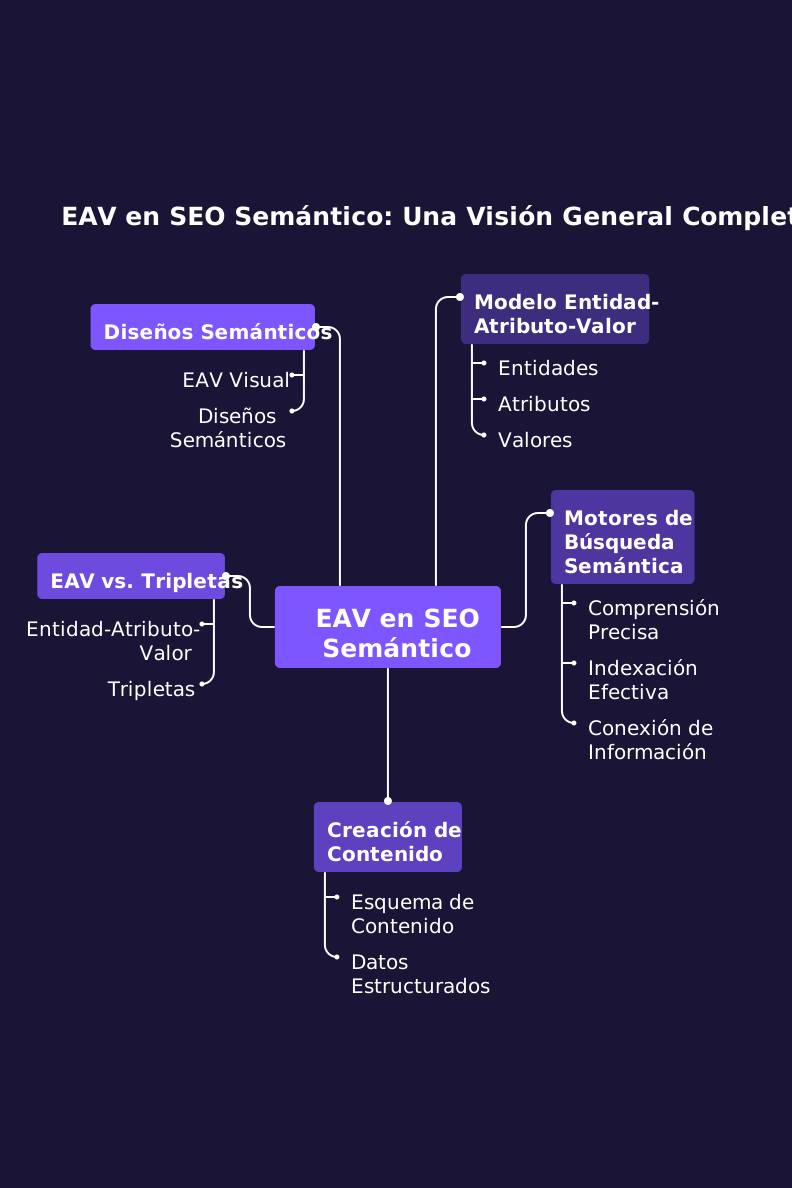
These points summarize the article’s EAV definitions, workflow, comparison, and validation path.
- EAV components: An entity is described through relevant attributes and their concrete values, creating a clear editorial vocabulary for the rest of the article.
- Editorial workflow: EAV can help teams turn questions into headings, sections, and values that editors can review without treating the model as a ranking mechanism.
- EAV and semantic triplets: EAV describes characteristics of one entity, while subject–predicate–object triplets describe directed relationships between a subject and an object.
- Visual and validation layer: Tables, lists, and rendered checks can make the relationships easier to inspect; structured-data eligibility follows separate documented requirements.
Understanding the Entity-Attribute-Value Model in Search
The Entity-Attribute-Value (EAV) model is a conceptual framework that structures data by defining a subject (Entity), a characteristic to measure (Attribute), and the specific data point or descriptor assigned to it (Value).
In database management, EAV is a flexible way to represent sparse attributes. That comparison is useful for understanding the vocabulary, but semantic SEO uses the model here as an editorial lens for organizing entity questions and facts; it should not be treated as a claim that the open web or search engines implement the same database design.
In semantic SEO, EAV is a useful modeling and content-organization framework for making the relationships among a subject, its attributes, and their values explicit. For example, a page about a specific smartphone can organize its weight as an attribute with a corresponding value, and do the same for its operating system, without assuming that a search engine processes the page through a confirmed EAV workflow.
The Three Components of an EAV Model
To implement EAV successfully in semantic SEO, content managers must understand how these three components interact.
- Entity: This is the central node or noun. It can be a person, place, physical object, concept, or brand. In your topical maps, entities represent the core subjects of your pages.
- Attribute: This is the parameter, characteristic, or query dimension associated with the entity. It represents what users want to know about the entity.
- Value: This is the concrete answer, measurement, or data point that satisfies the attribute. Without a clear value, the attribute remains an unanswered question.
| EAV component | Meaning in this editorial model | Example for a semantic SEO page |
|---|---|---|
| Entity | The central subject being explained. | Semantic SEO audit |
| Attribute | A characteristic or question dimension associated with that subject. | Audit scope |
| Value | The checked answer, measurement, or descriptor assigned to the attribute. | Information architecture, links, rendered HTML, and selected GSC evidence |
The workflow below shows how to apply the model during planning and review.
How EAV Can Support Semantic SEO Workflows
EAV is best treated here as an editorial model for describing entity–attribute–value relationships. It can help a team organize questions, facts, and page sections, but this article does not establish it as a confirmed search-engine workflow or a guarantee of accurate results. For site-level planning, compare the model with the Topical Maps for Semantic SEO: Complete Framework & Step-by-Step Guide [2026] framework when deciding which page should own a question.
In this article, EAV is a practical organizing model for describing an entity through its attributes and values. Content can therefore be reviewed as relationships among entities, attributes, and values without treating that model as a confirmed ranking mechanism or as a substitute for documented search features.
When your content is organized logically around these pairs, readers and editors can inspect the relationship between an entity, attribute, and value more easily. Use verified values and explicit labels when presenting facts; this can improve clarity and reviewability, but no direct effect on relevance, authority, or eligibility for a particular search feature is established here.
💡 Actionable Insight: For clearer editorial review, align your entity mapping with a consistent architectural framework. The strategic planning steps in the Koray Framework can help a team organize site-wide entities and nested attributes for review; this does not guarantee rankings or crawler behavior.
Implementing EAV in Content Creation and Outlining
Implementing EAV in content creation involves structuring an article so sections answer relevant attributes of the main entity, with a logical hierarchy and clear headings.
To plan semantic content, use EAV during the outlining phase to make the entity, relevant attributes, and expected values explicit. Each heading can represent an attribute of the target entity without implying a ranking outcome.
Consider the following structured workflow to implement EAV in your writing process.
- Identify the core Entity: Determine the primary keyword or topic of the page (e.g., “Active Directory”).
- Map the required Attributes: Conduct search intent research to find what users ask about this entity (e.g., “Definition”, “Security Protocols”, “Port Requirements”).
- Design headings as Attribute Indicators: Write your H2s and H3s so they clearly state the attribute being discussed. Avoid vague titles like “Important things to know” in favor of “Active Directory Security Protocols”.
- State the Value immediately: Open the section directly with the value or answer. Do not bury the main data point under paragraphs of fluff.
Keeping an attribute and its value close together in the HTML document can improve human readability and editorial review. In this article, that proximity is a presentation recommendation, not a claim about a search-processing mechanism or ranking factor.
EAV vs. Triplets: Key Structural Differences
While EAV structures data around a central entity by defining its individual properties, semantic triplets (Subject-Predicate-Object) establish directional relationships between two distinct entities to build a web of meaning.
In semantic web technology, it is common to compare the EAV model with the Triplet model (commonly used in W3C’s “RDF 1.1 Concepts and Abstract Syntax” (2014) and knowledge graphs). While they share similarities in breaking down information into three-part systems, they serve slightly different functions in data representation. EAV is highly focused on describing the internal characteristics of a single entity, whereas a triplet maps how one entity connects to an entirely different external entity. For a structured-knowledge example, see the DBpedia Association’s DBpedia project.
| Feature / Dimension | Entity–Attribute–Value (EAV) | Semantic Triplets (S-P-O) |
|---|---|---|
| Primary Focus | Describing characteristics of a single entity. | Defining relationships between two separate entities. |
| Database Structure | Vertical tables (one possible analogy for sparse attribute lists). | Graph databases (a separate analogy for connected entities). |
| SEO Application | Organizing on-page copy, tables, and product specifications. | Schema markup describes machine-readable page data; internal linking provides contextual navigation; related-entity planning maps adjacent questions. |
| Example Formulation | [E: JavaScript] -> [A: Paradigm] -> [V: Multi-paradigm] | [S: JavaScript] -> [P: createdBy] -> [O: Brendan Eich] |
Understanding both models allows you to write content that is strong in both internal description (EAV) and external contextual linking (Triplets). When you construct your content, internal links can express a contextual relationship between one page (subject) and another (target); they are not automatically formal RDF predicates or schema relationships.
Structuring Web Pages with Semantic Layouts and Visual EAV
Visual EAV involves designing web layouts—such as comparison tables, attribute badges, and product cards—that group attributes and values together for human readability and editorial review.
Semantic HTML gives readers and editors a clearer way to inspect how an attribute relates to its value. Google Search Central documents structured-data implementation separately; grouping arbitrary EAV relationships in a table or definition list does not by itself guarantee crawler extraction or a search feature.
For example, if you list product specifications in a long, winding paragraph, a reader may find it harder to associate each number with its feature. Presenting the data in an HTML table, a definition list (`<dl>`), or structured bullet points keeps each attribute close to its value and improves readability and reviewability. This implementation does not guarantee rich results or product snippets; see Google Search Central’s “Introduction to structured data markup in Google Search” (updated 2026-06-15) for implementation guidance.
This organized layout can support site-level planning by making the relationship between a page and its wider topical map easier to review. See the Topical Maps for Semantic SEO framework for the site-level planning method; it does not guarantee that a page has no orphaned information or semantic gaps.
Worked Example: Mapping a Semantic SEO Audit with EAV
Use this example as an editorial workflow, not as a ranking formula.
| EAV step | Worked example |
|---|---|
| Entity | Semantic SEO audit — the page explains how to review a page and its surrounding content network. |
| Attributes from the question network | Definition, audit scope, information architecture, internal links, rendered integrity, and GSC evidence. |
| Verified values | Each value comes from the live page, its rendered HTML, linked targets, schema, or the selected GSC date range. If a value cannot be checked, label it as unverified instead of filling the gap. |
| Resulting outline | H1: “Semantic SEO Audit”; H2: “What Does a Semantic SEO Audit Check?”; H2: “How to Verify the Findings”; H2: “How to Repair the Page and Its Links”. |
| Contextual link | When the workflow reaches the audit method, link the phrase Semantic SEO Audit Guide to the dedicated guide because it owns the step-by-step audit question. |
| Validation | Check that the H1 answers the central question, each H2 covers a declared attribute, every factual value has a source or live check, the internal link matches its target H1, and the rendered schema agrees with the visible answer. |
This sequence shows how EAV turns a concept into a reviewable brief. It makes the editorial relationship explicit without claiming that the model alone determines ranking, indexing, or search-feature eligibility.
Validation Checklist for EAV-Optimized Content
A validation checklist helps editors maintain semantic clarity, match user intent, and review entity–attribute–value relationships on the page.
Before publishing any new article, content editors should evaluate the page’s structure against this technical quality checklist.
- Core Entity Identification: Is the primary entity clearly defined in the first paragraph using a simple “is-a” or “is-the” statement?
- Attribute Heading Alignment: Do your subheadings (H2, H3) clearly represent the attributes that the page intends to explain to readers and editors?
- Value Proximity: Are the values positioned immediately adjacent to their corresponding attributes within the body text or tables?
- HTML Semantic Elements: Have you utilized structured HTML tags (like `<table>`, `<ul>`, or `<ol>`) to house dense attribute-value lists?
- Schema Markup Alignment: Does your structured JSON-LD schema (e.g., Product, FAQ, or Organization) match the exact EAV values displayed in your visible on-page copy? Compare the vocabulary with Schema.org’s schema vocabulary.
Conclusion: Using EAV in Semantic SEO
EAV is a practical editorial model for making an entity, its relevant attributes, and their values explicit during planning and review. Use it to organize a brief, inspect coverage, and decide which page or section should answer a question; do not treat it as a guarantee of rankings, indexing, or search-feature eligibility.
Ready to review an entity–attribute–value outline? Pos1 can help you plan a clearer semantic content structure.
Frequently Asked Questions
What is the difference between an entity and an attribute in SEO?
An entity is the primary subject or noun of a page (e.g., a specific brand or software), while an attribute is a specific characteristic or property belonging to that entity (e.g., pricing, founder, or launch date).
Can EAV guarantee a Featured Snippet?
Clear entity-attribute-value wording can make the relationship between an entity, an attribute, and its value easier for readers and editors reviewing the page to understand. This organization may improve answer clarity and extractability, but it does not guarantee a Featured Snippet or any other search feature.
Do I need custom schema markup to use the EAV model?
Structured schema markup (JSON-LD) is a separate implementation layer from an EAV editorial model. Clean HTML tables, ordered lists, and clear headings can make the relationships easier for people and editors to review, but they do not guarantee search extraction or a search feature.
Can EAV modeling improve my site’s topical authority?
EAV modeling does not by itself establish or guarantee improved topical authority or search rankings. By mapping relevant attributes and their values, it can support a more coherent topical map, clearer organization, and more complete coverage of the questions a page intends to answer.
Google Search Central, “Introduction to structured data markup in Google Search” (updated 2026-06-15), supports the structured-data implementation and search-feature eligibility boundary discussed above.
W3C, “RDF 1.1 Concepts and Abstract Syntax” (2014), defines the subject–predicate–object model used in the EAV comparison.
Schema.org, schema vocabulary, is the reference used for the schema-alignment check in the validation section.
DBpedia Association, DBpedia project, is the structured-knowledge example used in the triplet discussion.
📚 Guía completa: Koray SEO Framework: Semantic SEO Editorial Guide
Ready to dominate topical authority in your industry?
We engineer entity architectures, semantic knowledge graphs, and high-density content networks that search engines reward with lasting rankings. B2B agency retainers ($1,500 – $6,000 USD/mo) or Complete Domain Audit for $97 (100% credited toward your retainer).