


Technical review: Barbara Briceño · professional in virtual education and virtual tutor, with experience in instructional design, Moodle, and e-learning training
Semantic SEO Internal Linking: How to Connect Entities, Attributes, and Pages
Semantic SEO internal linking is the editorial practice of connecting pages through explicit entity relationships, attributes, and contextual hierarchy rather than relying only on matching keyword strings. In this article, internal linking is the central entity; context, anchor meaning, graph auditing, crawl paths, and implementation are its working attributes.
Key Takeaways
- Entity-Attribute Bridges: Internal links function as semantic connectors that map a central entity to its specific properties across a topical map.
- Contextual Vector Prominence: Record placement within main-body paragraphs and heading context as audit variables; this article does not assign them a fixed ranking weight.
- Structural Integrity: Using a diverse mix of descriptive anchor text establishes clear source-to-target alignment while avoiding over-optimization.
- Systematic Edge Auditing: Regular HTTP validation and relevance checks of directed edges prevent context dilution and technical link degradation.
For this guide, semantic SEO internal linking is an editorial method for making entity-to-attribute relationships explicit between pages. Pos1 publishes practical SEO audits and editorial frameworks for teams that need to make those relationships reviewable; this article focuses on the internal-linking layer. Use descriptive, crawlable links so readers and crawlers can follow the intended path. Google Search Central supports this implementation in its “Links are crawlable” documentation (accessed 12 August 2026); the World Wide Web Consortium (W3C) documents the RDF model in its 25 February 2014 “RDF 1.1 Concepts and Abstract Syntax” Recommendation, which this article uses as a planning lens. It does not claim that a particular link placement guarantees a ranking effect.
Within a semantic content network, internal links do more than provide navigation: they express a source-to-target relationship that readers can verify. Treat links as explicit entity-to-entity connections in the editorial model, while validating the target page, its context, and its live response rather than assuming that the graph alone proves authority or ranking impact.
Supplementary source links cited inline: World Wide Web Consortium (W3C), “RDF 1.1 Concepts and Abstract Syntax”; Google Search Central, “Links are crawlable”; MDN Web Docs, “HTML: The heading elements”; and Google Search Central, “SEO Starter Guide”.
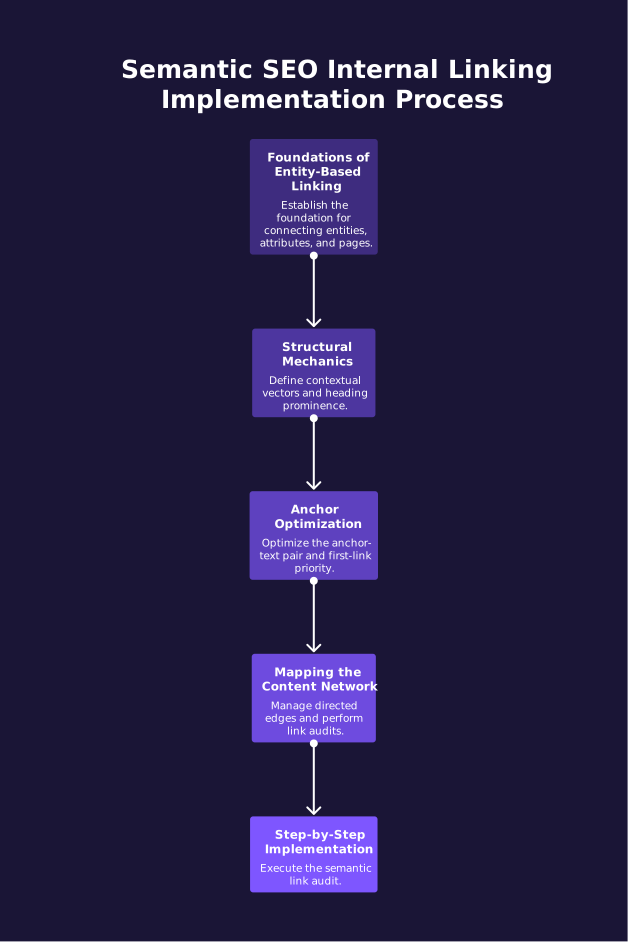
The Foundations of Entity-Based Internal Linking
Entity-based internal linking maps relationships between a central entity and its attributes, establishing a structured topical map where links serve as explicit semantic connectors. For the cluster’s canonical framework, consult the Koray SEO Framework: Semantic SEO Editorial Guide; for foundational context, review 7 Semantic SEO Fundamentals Every Marketer Must Know.
To design an effective semantic linking strategy, you must first understand the concept of a web page as an entity representation. In this article’s editorial model, an entity is a well-defined, singular concept—such as a person, place, physical object, or abstract idea. For the same model, a page is a representation of a central entity and its associated attributes, not a claim about how every search system stores or interprets documents.
When constructing this topical map, editors can arrange pages hierarchically to represent entities and attributes. Rather than linking pages together haphazardly, the editorial model uses an Entity-Attribute-Value (EAV) bridge: it connects a main topic (the Entity) to sub-components (the Attributes) via internal links. Treat this as a planning method, then validate every edge against the live target. For example, if a primary pillar page represents the entity “semantic search,” a link pointing to a secondary spoke page covering “schema markup” acts as an explicit bridge, establishing “structured data” as a key attribute of “semantic search.” The related phrase is repeated in plain prose to explain the entity-attribute relationship, not only as anchor text.
A subject-predicate-object vocabulary is used to model metadata; the World Wide Web Consortium (W3C) documents this structure in its 25 February 2014 Recommendation, “RDF 1.1 Concepts and Abstract Syntax”. This article uses that vocabulary as an editorial analogy for reviewing source, relationship, and destination; it does not claim that an internal-link graph is an RDF dataset or that the analogy validates topical authority. The three primary roles in this editorial model are defined below.
- The Subject is the source page containing the link.
- The Predicate is the relationship or action the source page expresses about the entity and its attribute; the anchor text and surrounding context communicate that relationship to the target page.
- The Object is the target page receiving the link.
By defining these connections intentionally across your content library, you give editors a traceable way to explain how topics relate. Validate each edge through its source context, target H1, canonical URL, HTTP response, and user path; do not treat the editorial model as proof of how a ranking system assigns authority.
Use the semantic content network guide to map source-to-target relationships before auditing live links.
Structural Mechanics: Contextual Vectors and Heading Prominence
For this audit, record a link’s position, surrounding context, heading proximity, and source-to-target distance as observable editorial variables. The Vault’s prominence-knob model treats H2 placement as broader editorial prominence and deeper H4/H5 placement as narrower contextual precision; validate the hypothesis through the target content and live graph rather than treating a heading level alone as a guaranteed ranking result.
For link-placement mechanics, distinguish the main editorial content from template and navigation zones such as headers, sidebars, and footers. Links in the main body can be supported by surrounding prose and headings that clarify the source-to-target relationship, while template and navigation links primarily serve site-wide traversal. Do not use “core” and “outer” for these layout zones. During QA, also verify that rendered CSS preserves the visual hierarchy—H2 more prominent than H3, and H3 more prominent than H4—without changing the semantic markup.
In topical-map architecture, Core and Outer describe a different distinction: Core coverage serves the commercial GO intent, while Outer coverage serves informational KNOW intent. Outer topics should bridge back to Core topics through shared middle-ground attributes, preserving a contextual route from informational coverage to the relevant commercial answer.
A contextual vector refers to the surrounding text that provides immediate meaning to a link. Surrounding prose, anchor text, and nearby headings can help readers and crawlers interpret the relationship between the source and destination pages. The heading hierarchy provides document structure, but this article does not establish that a link under an <h2> heading carries greater ranking weight than one under an <h4> heading. Treat that mechanism as a hypothesis rather than a confirmed ranking rule.
💡 Insight: As an editorial heuristic, a one-link-per-section distribution can keep the source-to-target relationship clear. Do not present this distribution as a proven algorithmic requirement; review each link’s relevance, surrounding context, and user value instead.
Optimizing the Anchor-Text Pair and First-Link Priority
Optimizing internal links requires aligning the anchor-text pair with the target page’s core entity and placing important links where the surrounding content explains their relevance.
The anchor text should describe the relationship between the source page and the destination page. Avoid generic phrases such as “click here,” “learn more,” or “read this post”: they do not identify the destination or give the reader enough context. Keep the heading hierarchy aligned with the document structure; MDN Web Docs explains this in “HTML: The heading elements”.
At the same time, search professionals should maintain natural anchor-text variation where it accurately describes the destination. Repeatedly using the exact same keyword phrase for every internal link pointing to a specific page may create a repetitive pattern, but this page does not establish that it triggers an over-optimization filter. For this site-wide audit, avoid over-optimizing one target with identical anchor strings more than three times; the cap applies to repeated anchor text for that target, not to every natural navigation label. Vary anchor text only when the alternatives remain accurate and useful to readers. For example, if you are linking to a page about “schema markup,” you might use diverse anchor terms such as:
- Structured data implementation
- Schema.org vocabulary
- Semantic HTML annotations
- JSON-LD code structures
This natural variation is an editorial heuristic for making the destination’s facets clearer to readers; it should not be presented as a guaranteed way to alter ranking systems.
Another technical aspect to keep in mind is first-link placement. If a page links to the same destination URL multiple times within its HTML body, record the first occurrence in the DOM and review whether its anchor and surrounding context provide the clearest user path. The available evidence here does not justify asserting that the first link passes a particular PageRank or relevance amount, or that later links pass none. Consolidate duplicate links when they are redundant, but retain a later link when a different, accurate anchor improves contextual relevance or user flow.
Mapping the Content Network: Directed Edges and Audits
Auditing directed edges involves validating source-to-target relevance, checking anchor-text alignment, and verifying HTTP status codes to maintain a healthy semantic content network.
In graph theory, a network is made of nodes connected by directed edges. In a semantic content network, the pages are the nodes and the internal links are the directed edges. To keep this network healthy, you must regularly audit these connections to ensure they are clean, accurate, and direct.
A thorough semantic audit requires analyzing the source-to-target relation of every internal link on a page. You must confirm that the link’s anchor text and the context of the source page match the target page’s primary <h1> heading. This target H1 alignment helps confirm that the expectation set by the source link is present, but the target opening definition and main content must also expand the promised entity-attribute-value relationship without contradiction. Misaligned links—such as using an anchor like “semantic search tools” to link to a page with an H1 of “How to Build Backlinks”—create semantic noise and weaken the overall topical map.
A semantic audit should separate observable checks from hypotheses about ranking systems. Verify each internal link’s relevance to the source context, live HTTP status, canonical destination, and crawl behavior; where possible, point directly to the live canonical URL and investigate broken links or redirect chains as technical conditions to review, without assuming how a search engine calculates ranking or PageRank signals.
The following table separates observable audit conditions for links in main editorial content from links in template or navigation areas:
| Placement Attribute | Main Editorial Content | Template / Navigation Areas |
|---|---|---|
| Semantic Value | Inspect the local paragraph, heading context, and target relationship. | Usually serves site-wide traversal; inspect whether the link is useful and crawlable. |
| Anchor Diversity | Highly flexible; dynamically altered to fit the natural prose. | Static; typically restricted to exact page titles or short labels. |
| Contextual Vector | Review the surrounding text and nearby HTML headings; record the relationship and its evidence. | Usually has less local prose; inspect whether the link remains useful, descriptive, and crawlable. |
| User Engagement | Measure through user paths or analytics when available; do not infer engagement from placement alone. | Often serves site-wide traversal; verify its purpose and usefulness in the template. |
Step-by-Step Implementation of a Semantic Link Audit
Implementing a semantic internal linking audit requires mapping your existing entity relationships, verifying link health, and optimizing anchor text to reflect clear topical hierarchy.
To audit and optimize the directed edges in your semantic content network, follow this reproducible graph procedure:
- Export the graph inputs: Build a node list of indexable URLs and an edge list of every internal
href, recording the source URL, anchor text, section, canonicalized target, target title or H1, resolution status, and source and target clusters. - Calculate URL degrees: For every URL, calculate in-degree (the number of inbound internal links) and out-degree (the number of outbound internal links).
- Check the structural hubs: Sort URLs by in-degree and compare the highest-in-degree hubs with the pages assigned to the Core section. Treat any concentration difference as an observation to investigate, not as proof that a page has greater ranking authority.
- Find traffic-backed orphans: Filter for URLs with in-degree equal to zero, then cross-reference that list with available page-level traffic data. Prioritize pages with real traffic instead of treating every zero-inlink page as an orphan opportunity.
- Review source-to-target alignment: For each internal edge, confirm that the anchor text and surrounding source context match the target’s primary
<h1>or title and that the canonicalized target is the intended page. - Verify placement and distribution: Record the first occurrence of repeated destinations, heading context, section distance, and duplicate or clustered links as editorial audit variables; do not assign them a fixed ranking weight.
- Confirm suspected dead targets in production: Separately check each unresolved or suspected target against the live production site before labeling it broken. Distinguish a repository-absent target from a confirmed live 404 and record redirects or canonical variants separately.
- Fix confirmed internal failures: When an internal target is confirmed dead, repoint links you control to the appropriate live canonical page rather than relying only on a redirect, while preserving the anchor-to-target meaning.
Operationalizing Core/Outer bridges
Compare the topic terms used by the Core and Outer branches, identify shared middle-ground attributes, and verify that each required bridge link resolves to the intended canonical page. Flag an Outer topic with no relevant bridge to a Core page for editorial review; the presence of a link is not enough if the anchor and target H1 do not match.
Worked Core/Outer bridge
For example, this informational page is an Outer node about semantic SEO internal linking. Its shared middle-ground attribute is the semantic SEO editorial framework, so the intended bridge is the descriptive anchor semantic SEO editorial framework to the configured Core guide. The reviewer can record the source, anchor, target H1, canonical URL, HTTP status, and intent before accepting the edge.
Sample audit record
| Source | Anchor / target | Context and result | Action |
|---|---|---|---|
| /semantic-seo-internal-linking/ | semantic SEO editorial framework → /koray-framework-semantic-seo-guide/ | Finding: Core/Outer bridge is aligned; target H1, canonical, and HTTP result are valid. | Decision: keep the edge while intent and live response remain aligned. |
Conclusion: Audit the Relationship, Then the Link
Semantic SEO internal linking is easiest to improve when each edge has a clear entity, attribute, anchor, target H1, canonical destination, and live HTTP result. Start with the source-to-target relationship, validate the page and link, then choose whether to retain, refine, relocate, or remove the edge. That sequence keeps the audit actionable without assuming that any single placement guarantees a ranking outcome.
Supplementary content
Want a directed-link review? pos1.ar can scope source-to-target relevance, canonical resolution, HTTP status, and the next editorial action.
Frequently Asked Questions
What is the difference between keyword-based and semantic internal linking?
Keyword-based internal linking focuses primarily on matching exact keyword strings to help a page rank for specific search queries. Semantic internal linking focuses on the relationships between concepts (entities) and their attributes, building a clear topical map that explains how your pages relate to each other.
How many internal links should be placed in a single section?
As a starting heuristic, use roughly one deliberate link per section when it serves the reader and clarifies the hierarchy. Adjust the number for the topic, link necessity, and crawl path rather than treating it as a universal rule.
Does the position of an internal link within the HTML document matter?
Yes. The first occurrence of a repeated destination in the DOM is useful to record during an audit. Treat its placement as an editorial prioritization heuristic: put important links where the surrounding paragraph explains the relationship, but do not present this as a confirmed fixed PageRank or relevance rule.
How do semantic links support a topical map?
Semantic links act as directed edges that connect a central entity page to related topics and attributes. This explicit structure gives editors and readers a way to inspect the intended path; it may support clearer traversal, but it is not by itself evidence of a fixed ranking effect.
Ready to dominate topical authority in your industry?
We engineer entity architectures, semantic knowledge graphs, and high-density content networks that search engines reward with lasting rankings. B2B agency retainers ($1,500 – $6,000 USD/mo) or Complete Domain Audit for $97 (100% credited toward your retainer).