

Semantic Content Networks: Organize, Connect & Audit

Central question: How can an editor organize pages around one entity, connect the relevant contexts, and validate the internal-link path without treating the framework as a ranking guarantee? This guide answers that question through a documented semantic content network.
- Semantic content networks prioritize entity-attribute-value relationships over isolated keyword repetition.
- A documented taxonomy dividing content into root, seed, and node pages gives editors a clearer way to review coverage and crawl paths.
- Internal links act as semantic pathways, where anchor text, link order, and proximity define topical context.
- A five-column semantic brief records query terms and entities, ordered questions and intent, heading hierarchy, format and length, and connected internal links.
Search systems and SEO practice continue to evolve, so this guide treats entity and context modeling as an editorial framework rather than a complete description of proprietary ranking systems from analyzing isolated keyword strings to mapping complex, real-world concepts. As public documentation and research discuss natural-language processing and retrieval systems, the way web content is structured must evolve accordingly. For this guide, editors should avoid disjointed, keyword-stuffed drafts and instead document a cohesive page system. The recommendation concerns content planning and review; it is not a universal claim about how retrieval systems parse or rank every site.
Scope statement: The central entity of this page is the semantic content network; POS1 semantic SEO and content-architecture practice is the source context; editors and technical content teams are the audience; and the central search intent is to organize pages, connect contexts, and audit the internal-link path without treating the model as a ranking guarantee.
The Evolution from Keywords to Contextual Architecture
Source notes for the framework: Public search documentation describes how information is organized; Google Search Central, How Google Search Works, is used for that description; W3C, Semantic Web standards, provides context for linked data; Schema.org, official documentation, informs the structured-data terminology; and David C. Taylor, Google Patent US9449105B1, “User-context-based search engine,” consulted 12 August 2026, is treated only as mechanism research about contextual entities, not as proof of a current ranking rule.
Transitioning to semantic SEO shifts focus from isolated keywords to structured systems of entities and attributes. This architecture is an editorial model for representing entities, context, intent, and relationships. It can be compared with public search documentation and research, but it does not establish a universal description of proprietary processing.
A simplified historical account often contrasts exact-match keyword analysis with broader contextual approaches; this article uses that contrast as an editorial explanation, not as a complete history of search systems. The POS1 semantic SEO hub provides the broader topical context for this guide. Public documentation describes systems that organize and rank information; Google Search Central, “How Google Search Works,” accessed 12 August 2026 is cited for that public description, and it does not publish a complete proprietary formula. The patent reference in this article is mechanism research only: David C. Taylor, Google Patent US9449105B1, “User-context-based search engine,” consulted 12 August 2026, is not evidence of a current ranking rule. In this article, entity and context language is therefore an editorial model, not a universal claim about every query. In this editorial model, an entity can be a person, place, object, or abstract concept. Mapping those relationships helps the editor document the page’s subject and attributes; any effect on search results must be tested with current site evidence.
When planning a search engine optimization campaign, treating a cluster as a flat keyword list often leads to disjointed writing and cannibalization. A semantic content network, by contrast, uses a structured query-and-entity architecture. Instead of writing multiple articles targeting variations of the same search phrase, you construct distinct nodes that address specific attributes of a central subject. This contextual architecture gives editors a way to document source context and central search intent without asserting how proprietary systems process the content, clarifying the source context of your domain and matching the user’s central search intent more accurately.
Using the Entity-Attribute-Value (EAV) Model as an Editorial Framework
To construct an effective semantic content network, it is useful to understand how information is represented in structured databases. The Entity-Attribute-Value (EAV) model is a conceptual editorial framework for documenting how a page expresses a subject, its attributes, and their values; it is not presented here as a description of any proprietary search-engine implementation.
- Entity. This is the primary subject or concept being discussed (e.g., “Semantic SEO”).
- Attribute. This is a characteristic, feature, or parameter of that entity (e.g., “Core Strategy”).
- Value. This is the specific data or content that describes the attribute (e.g., “Semantic Content Networks”).
By structuring pages around a central entity and its attributes, editors create a documented roadmap of intended semantic relationships. Treat that roadmap as an editorial model and validate any crawl or search effect with live evidence. Rather than hoping an algorithm guesses the connection between your pages, you explicitly define those connections through text structure, schema markup, and logical internal link pathways.
Establishing a Semantic Content Network
At pos1.ar, we publish semantic SEO guidance and provide content-architecture and semantic SEO audit work for editors and technical content teams. The POS1 semantic SEO hub provides the broader topical context for this guide. This informational guide is designed to clarify how a semantic content network can function as a structural blueprint, assisting in the alignment of an information tree and topical map. While this approach is intended to help search engines and users understand how topics relate, it is provided strictly as a methodology for logical site structuring rather than as an assurance of search performance.
Under this framework, editors can use core/outer distinctions and contextual links as a review method to evaluate how different sections relate to the central entity and central search intent. Analyzing these relationships conditionally allows teams to check if heading hierarchies and internal links are structured systematically across the domain, providing technical teams with a way to plan and maintain an auditable information architecture.
Structural Taxonomy: Root, Seeds, and Nodes
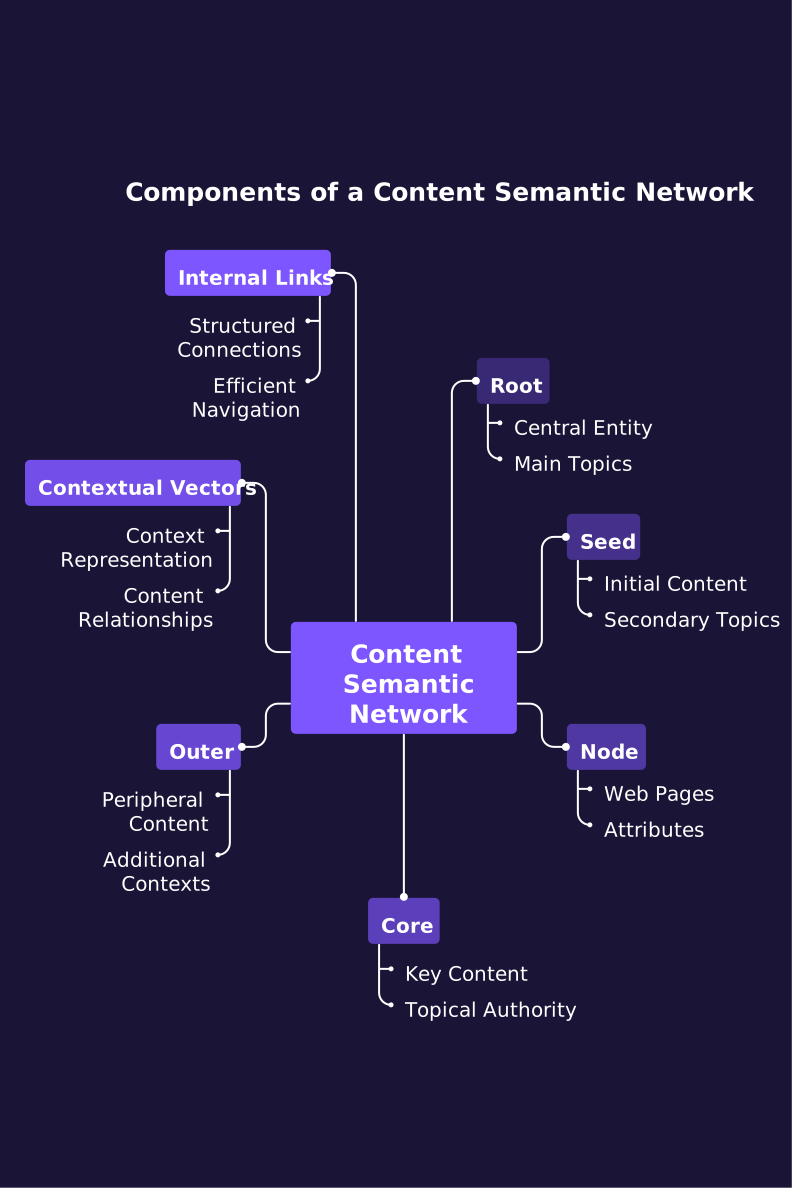
A semantic content network relies on a strict taxonomy of root, seed, and node pages. This system maps a website’s central entities to secondary attributes, ensuring clean contextual flows and logical internal linking paths across the entire domain.
A semantic content network must have a clear hierarchical taxonomy to remain manageable and effective. Without a logical structure, websites risk creating “content drift,” where articles lose thematic cohesion and begin competing with one another for the same search queries. To prevent this, architects categorize content into three distinct levels: the root, the seed pages, and the node pages. This hierarchy is intended to organize URL paths, navigation, and the planned contextual relationships between pages. Any effect on link equity or search performance is a hypothesis to validate with crawl data and GSC, not an outcome asserted by this guide.
💡 Insight: A clear, descriptive URL structure helps editors and users understand the site organization; measure any crawl effect with the site’s own crawl data. Google Search Central’s URL structure guidance recommends simple, descriptive URLs for users and search systems; this article applies that recommendation as an editorial convention, not as a ranking guarantee.
To visualize this taxonomy, consider the following illustrative hierarchical URL pattern for a site specializing in search engine optimization concepts. These paths are a conceptual hierarchical pattern, not the current POS1 URL map. The live links elsewhere in this article intentionally retain each destination’s verified canonical path; do not treat this pattern as a duplicate mapping.
Root pattern: /en/semantic-seo/ — verified destination: POS1 semantic SEO hub.
- Seed pattern. /en/semantic-seo/topical-maps/ — verified destination: Topical Maps and Semantic SEO Framework.
- Node pattern. /en/semantic-seo/eav/ — verified destination: What Is EAV in Semantic SEO.
- Node pattern. /en/semantic-seo/audit/ — verified destination: Semantic SEO audit guide.
These are illustrative path patterns; the linked destinations are the live canonical URLs to audit and use.
In this architecture, each level serves a specific semantic purpose. The Root acts as the broad thematic gateway. The semantic content network remains the governing entity; POS1 semantic SEO is the source context, while the Seed represents the network hub and the Node pages represent supporting attributes such as EAV, topical maps, and audits. The Node pages explore those attributes while linking back when that path serves the reader’s next question.
Topical Maps and Semantic SEO Framework
A semantic network should distinguish the Core/Outer content split from the Root/Seed/Node information tree. See the Topical Maps and Semantic SEO Framework for the broader map context. Core describes deeply processed, high-priority GO or commercial attributes that deserve complete instance coverage and a direct route to the relevant conversion path; Outer describes flatter KNOW coverage that supports the context and links back when the relationship is justified.
Root, Seed, and Node describe network and URL layers, not fixed Core or Outer labels. A Seed can be a Core or Outer page depending on its intent and depth, and a Node can also carry a high-priority attribute. Assign each page by its actual query role, topical border, and required path rather than by its position in the information tree.
Tactical Comparison: Traditional Keyword Silos vs. Semantic Content Networks

In this editorial comparison, traditional keyword silos are modeled as pages organized around rigid directory structures and repeated query terms. A semantic content network is modeled as pages connected through entity relationships, contextual relevance, and deliberate multi-directional links; these are content-planning choices, not claims about how any search system ranks pages.
Many editorial strategies use keyword silos as a planning model. In this simplified comparison, pages are grouped by directory paths and cross-links between silos are limited. An editorial network instead represents cross-topic relationships for review when the connections are logical and contextually supported; this comparison describes alternative organization choices and does not establish how early or current search systems interpret them.
A semantic content network differs by focusing on relational mapping rather than strict directory isolation. For the broader method, see the Koray SEO Framework semantic SEO guide. Instead of restricting links to vertical directories, a semantic network allows horizontal and diagonal internal linking between nodes of different clusters, provided there is an authentic conceptual relationship between the entities on those pages. This approach gives editors an analogy for organizing related concepts; it does not establish how search systems model human learning or behavior.
The following table outlines the technical and conceptual differences between these two methodologies.
| Architectural Feature | Traditional Keyword Silos | Semantic Content Networks | Primary SEO Benefit | Search Engine Processing |
|---|---|---|---|---|
| Primary Target Unit | Exact-match keyword strings | Entities and query networks | Editorial objective: reduce avoidable overlap between pages | Editorial model: document entities and their attributes |
| Internal Linking Flow | Strict vertical parent-child links | Relational cross-cluster linking | Editorial objective: balanced internal-link paths | Editorial comparison: graph-style link review; PageRank variations are not asserted here as current ranking rules |
| Structural Directory Dependency | Editorial comparison: higher dependence on folder structures | Editorial comparison: lower dependence when link relationships carry more of the organization | Greater site architecture flexibility | Editorial audit variable: link proximity and context |
| Content Scale Strategy | Creating thin pages for every keyword variant | Comprehensive coverage of sub-topics per node | Editorial objective: clearer coverage and a more useful reading path | Natural-language processing concepts discussed in public documentation or research; verify scope before using them as a current-system claim |
The Semantic Internal Linking Framework: Anchor Text, Order, and Prominence
Internal linking within a semantic network is defined by link order, anchor text context, and proximity. These factors give editors review criteria for documenting relationships and intended priority between entity nodes within a topical cluster; validate any crawler response separately.
Within a semantic content network, contextual internal links can act as bridges between related pages when the source coverage, target intent, anchor, placement, and surrounding explanation justify the relationship. They are one part of the network model, not a universal or exclusive explanation of how search systems associate concepts. When building these pathways, webmasters must pay close attention to anchor text, link placement, and the order in which links appear within the document. It is critical to state that while optimized internal links are vital for structure and crawlability, they do not act as a replacement for high-quality external backlinks, nor are they the single strongest ranking signal in modern search algorithms.
Editors can audit link order and prominence as user-context variables; any effect on search processing should be treated as a hypothesis to validate, not a universal rule. Some search patents discuss mechanisms related to user interaction and document presentation, but a patent is mechanism research rather than proof of a current ranking rule. In this editorial framework, place a link in the main body only when its context helps the reader and its source-to-target relationship is clear. The anchor text should be descriptive and use natural language variations to clearly name the destination entity, providing context to both users and crawlers before a click occurs.
💡 Optimization Tip: When linking between nodes, prioritize natural, descriptive anchor texts that explicitly name the target entity or its attribute. Avoid generic phrases like “click here” or “read more,” which offer zero semantic value to search engine parsers.
A Directed-Link Audit Procedure for Topical Integrity
To ensure that your internal links are actively reinforcing your semantic network rather than diluting its focus, content managers should conduct regular link audits. This step-by-step procedure helps maintain high topical integrity across your site.
- Map the current URL hierarchy. Export your site’s URLs and classify each page as a Root, Seed, or Node. This step ensures you have a visual map of your architecture.
- Extract the current link paths. Use a crawler tool to run a site-wide crawl. Export the internal link graph, detailing the source URL, destination URL, anchor text, and link location (body, header, footer).
- Identify orphan pages and isolated clusters. Use the Semantic SEO audit guide as a procedural reference while building a directed URL-and-edge inventory and calculating in-degree and out-degree for each node. Identify zero-inbound pages first, then define an actionable orphan as a zero-inbound page with verified GSC clicks or impressions. Rank those traffic-bearing orphans, keep zero-traffic zero-link pages as a separate inventory condition, confirm whether Core pages function as hubs, and live-check any suspected broken target before reporting it.
- Evaluate anchor-text semantic value. Review your internal anchor texts. Check that anchors clearly name the destination concept, are justified by the surrounding coverage, and are not generic. Review anchor diversity and source-to-target alignment qualitatively rather than applying a fixed percentage.
- Apply logical cross-linking rules. Check whether a node-to-seed link is contextually useful, necessary for the intended crawl path, and aligned with both page roles; add it when that relationship is justified. Limit cross-links between unrelated seeds unless there is an authentic, contextually justifiable relationship between their respective entities.
Worked audit output: how to classify one edge
This worked example is illustrative, not an observation from POS1. The same record format can be populated from a crawler, GSC, and an HTTP check before an editor changes a link.
| Source URL | Target URL / anchor | Location | In / out-degree | Traffic, live check, action |
|---|---|---|---|---|
| /en/semantic-seo/ | /eav-semantic-seo/ — “What Is EAV in Semantic SEO” | Main body, EAV paragraph | Target in-degree 3; source out-degree 4 | Illustrative GSC impressions present; HTTP 200; retain as a contextual bridge |
| /semantic-content-network/ | /semantic-seo-audit-guide/ — “Semantic SEO audit guide” | Audit procedure | Target in-degree 1; source out-degree 3 | Illustrative GSC clicks present; HTTP 200; confirm the target answers the procedure |
| /semantic-content-network/ | /old-audit/ — “Semantic SEO audit” | Legacy paragraph | Target in-degree 0 | Illustrative HTTP 404; remove or replace only after confirming the live response and owner |
After exporting the complete edge list, compare hub concentration with the Core/Outer role, prioritize traffic-bearing zero-inbound pages, and record the before/after crawl path. A link change is complete only when the destination is live, the anchor fits the surrounding answer, and GSC or crawl evidence is scheduled for review.
Building the Brief: Creating a Worked Five-Column Content Plan

A semantic content brief maps contextual vectors, query networks, and entity relationships before writing begins. This ensures that every piece of content satisfies specific search intents while naturally integrating into the broader semantic network.
Before writing any content, it is crucial to outline how the new page fits into the broader semantic network. This is achieved by creating a highly structured semantic content brief. Unlike traditional SEO briefs that simply list target keywords to repeat throughout the text, a semantic brief focuses on mapping the query network, setting up the logical heading hierarchy, and pre-determining the incoming and outgoing internal links. This structured approach prevents content drift and ensures the writer remains focused on the primary intent vector of the page.
The following example details a worked, five-column mini content brief designed for a node page within an advanced SEO training website. This brief ensures that the writer addresses all necessary contextual questions while maintaining strict structural links back to the broader semantic system.
| Query Terms (Entities) | Ordered Questions (Intent) | Heading Hierarchy (H2 / H3) | Format & Length | Connected Internal Links |
|---|---|---|---|---|
|
– Semantic schema – Schema.org – JSON-LD – Entity description |
1. What is semantic schema markup? 2. How does JSON-LD connect web entities? 3. How do I implement schema for SEO? |
H2: Defining Semantic Schema Markup – H3: JSON-LD vs. Microdata H2: Connecting Web Entities via Schema.org – H3: Using ‘about’ and ‘mentions’ Properties |
Technical guide with a direct definition, comparison table, ordered procedure, and FAQ. Section budget: 200 words for definition/context; 350 for taxonomy; 300 for the audit procedure; 250 for the brief; 100 for conclusion/FAQ. Use one explanatory list or table per major section, descriptive alt text for each visual, claim-level citations, and a contextual internal link only where the target answers the surrounding question. |
Incoming: – From the Topical Maps and Semantic SEO Framework Outgoing: |
By defining these parameters before content creation begins, you give the finished document a defined place in the planned semantic web; validate the implementation against the live site, crawl data, and GSC. Writers can focus on answering real-world user queries naturally, while editors create a documented, contextually connected structure that can be reviewed for clarity and crawl-path intent; any effect on indexing or topical authority must be tested on the live site.
Conclusion
Comparing traditional keyword targeting with a semantic content network helps editors choose an architecture that matches the page set, source context, and user intent. By aligning your website structure with the entity-attribute-value model, designing clean structural taxonomies of roots, seeds, and nodes, and managing your internal linking pathways with strict contextual logic, you create a documented information architecture and a testable crawl path; sustained organic performance remains an empirical outcome to validate with crawl data and GSC.
As a next step, document one representative root, seed, and node from your own site, record the intended source-to-target links, and validate the resulting crawl path before expanding the network.
Ready to take the next step? POS1 can scope a semantic content-network review for your site.
Supplementary content
Frequently Asked Questions
What is the difference between a semantic content network and a traditional keyword silo?
A semantic content network organizes pages based on conceptual relationships, entity-attribute mappings, and flexible cross-cluster links. Traditional silos can be modeled as pages grouped mainly by vertical folders and repeated query terms; this simplified editorial comparison does not describe every search system.
Does building a semantic content network guarantee top search engine rankings?
No, implementing a semantic content network does not guarantee top search rankings. It is intended to give editors a logical way to review crawl paths, user-facing navigation, and contextual relationships. Validate those outcomes with crawl data, user feedback, and GSC instead of treating them as automatic effects.
How many node pages should be linked to a single seed page?
There is no universal number. The quantity of node pages depends on the complexity of the seed topic and the breadth of its attributes. Content networks should prioritize covering all relevant user search queries and intent variations naturally rather than hit an arbitrary page count.
Does anchor text order in body copy affect how link equity is distributed?
Patent-based discussion is omitted here because mechanism research is not evidence of a current ranking rule; validate link placement with the site’s own crawl and GSC data. A descriptive body link can be easier for a reader to find in context; validate crawl and performance outcomes rather than assume them.
Related reading
- Koray SEO Framework semantic SEO editorial guide
- What Is EAV in Semantic SEO? Entity–Attribute–Value Explained
- Semantic SEO Audit: Complete Step-by-Step Guide with Koray Framework C
¿Querés dominar la autoridad semántica de tu nicho?
Diseñamos e implementamos arquitecturas de entidades, grafos de conocimiento y contenido de alta densidad que Google posiciona de forma sostenida. Retainers mensuales de agencia ($1.500 — $6.000 USD/mes) o Auditoría Completa de $97 (100% acreditable en tu primer mes).