


Technical review: Barbara Briceño · reviewed educational clarity, accessibility, and instructional usability; professional in virtual education and virtual tutoring, with experience in instructional design, Moodle, and e-learning training
Semantic SEO Content Brief: How to Plan Pages Around Entities and Search Intent
What Is a Semantic SEO Content Brief?
A semantic SEO content brief is a planning document that turns a topical map into a page-level specification: it defines query terms, entity-attribute-value coverage, heading order, section formats, source requirements, visuals, and contextual internal links.
Central question: How should an editorial team turn entity research and search intent into a page brief that a writer can execute and a reviewer can verify?
Source context: pos1.ar publishes semantic-search strategy and editorial implementation guidance for teams that need to plan, connect, and review information-rich pages.
Reading path: definition → five-field specification → research workflow → brief architecture → EAV alignment → structure design → connection mechanics → pre-publication QA.
Traditional SEO content planning often starts with a list of keywords and word-count targets. In this article’s editorial model, each query is assigned to an entity, attribute, passage, section format, source requirement, and internal-link path. This guide does not claim that one planning format guarantees a ranking result; it explains how to make the intended page function explicit before drafting.
A semantic SEO content brief can serve as the operational bridge between a conceptual topical map and an article draft. It organizes entities, attributes, user questions, evidence, formats, and links so a writer can produce a page with a defined scope and reviewable information path; performance outcomes still require live measurement.
What the Five-Field Brief Must Specify
The five fields that provide the writer and reviewer with a complete contract for the planned page are detailed below.
- Query Terms: Lists the distinct questions and phrases the page must answer, grouped by the same central entity.
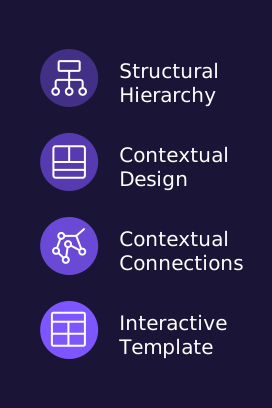
- Contextual Vector: Sequences those questions into an editorial progression that the writer and reviewer can inspect.
- Contextual Hierarchy: Maps the entity, attributes, and values to the page’s heading and section structure.
- Contextual Structure: Defines visual format, paragraph budget, evidence requirements, and promised user function for each section.
- Contextual Connection: Records the source section, target URL, anchor wording, and surrounding sentence for each planned internal link.
Research Workflow: From Search Evidence to Brief
Begin with a SERP inventory for the central question: record recurring result types, visible subquestions, terminology, and the pages that already address the intent. For the worked query “semantic SEO content brief,” an inventory template would record the result type, the question answered, the entity named, the section format, the source URL, and whether the result is informational or commercial; it must be completed from the current SERP rather than invented in the brief. Extract comparable headings and passage formats from relevant competitors, consolidate equivalent terms, and cluster distinct questions by entity and attribute. The resulting evidence becomes the input for the five-field brief; it does not replace editorial judgment or a live post-publication measurement plan.
The Core Architecture of a Semantic Brief
A semantic brief organizes search queries into a logical contextual vector of ordered questions, mapping out the precise information journey a user takes to resolve their intent.
This article uses an integrated Query Network rather than a flat keyword list. Each Query Term is assigned to the same document’s central entity, contextual vector, section format, evidence requirement, and internal-link path. As an editorial QA benefit, this structure gives the writer a defined scope, so query terms can be covered in context rather than repeated mechanically; it is not presented as a ranking guarantee.
To achieve this, the brief maps out a Contextual Vector. A contextual vector is the ordered sequence of questions and topics that a user naturally navigates when researching a subject. For this article, the worked example stays on the central entity: a semantic SEO content brief. A reader first needs the definition and purpose, then the EAV fields, query sequence, section formats, internal-link targets, and QA checks. That sequence is an editorial planning heuristic for a coherent reader path, not a claim about a universal search-engine preference.
When a page plan is ready, it can connect to the broader semantic content network. The worked table also links the planned semantic SEO internal linking guide so the writer can validate the target and anchor in the rendered article. In implementation terms, this page points to the network, the internal-linking guide, and the declared framework owner; the cluster’s pillar and sibling pages can receive reciprocal links during topology repair when the surrounding copy serves a clear reader path and the target answers the linked passage. The network defines how pages interact across a website, while the brief specifies the page-level entity, questions, sections, evidence, and links. For the cluster’s declared framework owner, consult the semantic SEO editorial framework; this article treats that framework as editorial context, not as proof of a ranking mechanism.
Ready to take the next step? pos1.ar can help scope the review.
Structural Hierarchy and Entity-Attribute-Value (EAV) Alignment
Contextual hierarchy translates the editorial entity relationships into heading levels that readers and reviewers can inspect; it is a planning structure, not a guarantee about crawler interpretation.
In this editorial model, a semantic SEO brief represents entities through attributes and values using Contextual Hierarchy. For the underlying entity-attribute model, see EAV in semantic SEO; this article uses that page as a supporting node, not as a substitute for the brief’s page-level contract. Heading levels are not merely visual choices in the brief: they document the relationship between a parent entity and its sub-attributes. The model should be validated against the finished page rather than presented as a description of how every search engine builds a knowledge graph.
For example, if the central entity of a page is “Remote Work Policy” (Entity), an H2 heading might be “Equipment Reimbursement” (Attribute). Under that H2, H3 headings would define specific values, such as “Laptop Specifications” or “Home Internet Stipends” (Values). This hierarchy gives the writer and reviewer a clear structure to inspect for topical alignment and missing attributes.
Mapping EAV Relationships to Heading Levels
To construct a highly scannable page, the brief must explicitly dictate how these heading levels are structured. The writer should receive a clear schematic showing exactly which sub-attributes belong under each main category. This gives the reviewer a concrete check for mismatched concepts under the same heading level and makes the intended topical scope easier to inspect.
Furthermore, each heading must be crafted to address specific search intents directly. Instead of using generic headings like “Details” or “Process,” headings should contain descriptive nouns and entities that reinforce the contextual scope of the section. This gives readers and reviewers a precise label for the section’s intended scope and evidence; the result is an editorial QA aid, not a claim about ranking impact.
Designing the Contextual Structure and Section Balance
In this brief, Contextual Structure records the visual format, semantic requirements, and length budget for each section so the finished page can be reviewed against an explicit contract.
A high-quality brief does not leave formatting decisions to the writer’s whim. It establishes a strict Contextual Structure that defines the exact format, visual elements, and necessary semantic requirements for each section. By specifying these parameters beforehand, you give editors a concrete way to review readability, answer format, and section completeness; any search-feature outcome must be validated with live measurement.
Section-length balance is another critical component of semantic design. If an attribute is highly complex and has significant search demand, the brief should allocate a larger portion of the overall word count to that section. Conversely, straightforward definitions should be kept concise. This targeted distribution of text prevents thin content while ensuring that writers do not generate fluff to meet arbitrary total word-count goals.
💡 Insight: Setting explicit visual contracts within the brief—such as mandating a comparison table for data or a bulleted list for steps—forces the writer to structure information cleanly. These visual contracts make the intended user function explicit; measure engagement and search features separately rather than inferring either outcome from a table or list alone.
In addition, the brief must document evidence alignment. Each externally checkable claim should identify the source, scope, and limitation that a reviewer can verify. The brief should list verified reference URLs and specify key industry terminology so a reviewer can check source-context alignment. For RDF terminology, the World Wide Web Consortium (W3C) defines the subject-predicate-object model in its 25 February 2014 Recommendation, “RDF 1.1 Concepts and Abstract Syntax”; that standard supports the vocabulary, not the broader ranking claims in this article. For search-system terminology, use Google Search Central, “How Search Works: How Google Search organizes information” as a product-documentation reference, not as proof that this brief earns a feature.
Establishing Contextual Connections and Link Anchors
Contextual connections outline the precise internal-linking targets and semantic anchor texts required to integrate the planned page into the site’s broader topical architecture.
A practical editorial risk is treating internal linking as an afterthought; this checklist makes the decision visible before publication. In a semantic SEO workflow, Contextual Connection is planned during the brief creation stage. The brief should identify useful source and target pages, then add each link only when the surrounding passage serves the reader flow and strengthens the target node; record the exact target URL and the sentence that justifies the anchor.
This micro-level planning distinguishes the semantic content brief from general internal-linking guides. While a sitewide linking guide looks at global site architecture, the brief controls the exact sentence-level context. It specifies the precise anchor text to be used, ensuring that the anchor consists of relevant entities and descriptive terms rather than generic phrases like “click here” or “read more.” This practice gives editors a traceable source-to-target relationship to validate for relevance, canonical resolution, HTTP status, and user path; it does not prove how a search engine assigns ranking weight.
The Worked Five-Field Semantic Brief Template
This worked template organizes research into five explicit fields: Query Terms, Contextual Vector, Contextual Hierarchy, Contextual Structure, and Contextual Connection. For each row, specify the preceding question, expected section length, table dimensions when relevant, citation quantity or source class, image/alt-text requirement, and promised user function. In the table, the last field records the source section, target URL, anchor wording, and placement context.
At pos1.ar, the editorial and SEO team provides semantic-search strategy, content planning, and internal-link review for teams building information-rich pages. This brief is intended for those editorial teams planning semantic SEO pages and reviewing their internal-link paths. To ensure that these principles are easily understood by writers, the instructions are presented in a structured, tabular format. This template breaks down each section of the planned page into actionable data points, eliminating ambiguity and keeping the writer aligned with the overall SEO strategy.
| Query Terms | Contextual Vector | Contextual Hierarchy | Contextual Structure | Contextual Connection |
|---|---|---|---|---|
| what is a semantic SEO content brief; why use an entity-based brief | Definition → purpose → inputs → output | H2 definition; H3 attributes and use cases | Format: paragraph with highlighted entity; definition box ≤45 words; direct answer; one example; 1 primary source link; section budget 120–180 words | Source: topical map; target URL: /semantic-content-network/; anchor: semantic content network |
| how to map EAV relationships in a brief | Entity → attribute → value → evidence | H2 entity; H3 attributes; H4 values where needed | Format: 4-column table (entity, attribute, value, evidence) plus short paragraphs; 1–2 source links; descriptive image/alt requirement if visualized | Source: EAV section; target URL: /eav-semantic-seo/; anchor: EAV entity-attribute model |
| how to order questions in a semantic SEO brief | Definition → mechanism → implementation → QA | H2 workflow; H3 stages and checks | Format: ordered checklist; 120–180-word section budget; 1 visual with descriptive alt text; 1–2 source links; passage candidate | Source: brief workflow; target URL: /semantic-seo-internal-linking/; anchor: semantic SEO internal linking |
| semantic SEO brief vs traditional SEO brief | Entity coverage and intent flow vs keyword list | H2 comparison; H3 decision criteria | Format: 5-column comparison table; evidence and limitations; 2 source links; intended reader function; 300–450-word section budget | Source: comparison section; target URL: /koray-framework-semantic-seo-guide/; anchor: editorial framework for semantic SEO |
Execution and Pre-Publication Quality Assurance Checklist
A rigorous pre-publication audit verifies that the written article matches the brief’s structural specifications, entity targets, and visual formatting rules.
Once the writer completes the initial draft, the content should be audited against the brief for entity coverage, query order, section format, source use, and contextual connections. This quality assurance (QA) stage catches deviations from the planned structure or omissions before publication.
- Verify Entity-Attribute Parity: Ensure that every entity and attribute specified in the brief has been clearly addressed and accurately defined within the text.
- Audit Contextual Vector Flow: Read the article sequentially to confirm that the transition between headings feels natural and matches the pre-defined user inquiry path.
- Check Formatting and Visual Contracts: Confirm that all mandatory visual elements—such as tables, definition boxes, and bulleted lists—have been formatted correctly.
- Validate Internal Link Anchors: Check that all requested internal links are implemented using the exact, semantically rich anchor text specified in the brief.
- Review Source-Context Alignment: Double-check that key terminology matches the authoritative references and primary sources listed in the brief. For structured-data vocabulary, compare the intended properties with Schema.org’s data model; for historical entity/attribute retrieval research, label the source and limits of Google Patent US8843466B1, “Identifying Entities Using Search Results,” published 23 September 2014, by Roni F. Zeiger et al.. This is retrieval-mechanism evidence, not a current ranking rule.
Conclusion: Turn the Map Into a Brief
A semantic SEO content brief turns a topical map into a page-level instruction set. Record query terms, contextual vector, hierarchy, structure, and connections; then validate the finished page against those fields, its sources, visuals, links, and promised user function. The next step is to use the completed brief to draft and semantic SEO internal linking audit before scaling the pattern across the cluster. If the team needs a scoped implementation review, pos1.ar can help define that review.
Supplementary content
These supporting resources and questions extend the brief without changing the page’s central entity.
Frequently Asked Questions
What is the difference between a traditional SEO brief and a semantic SEO content brief?
A traditional brief focuses on a list of individual target keywords, placement frequency, and overall word count. A semantic brief focuses on entities, mapping their attributes, defining logical query flows, and establishing visual structures to explain complex relationships clearly.
How do you define Entity-Attribute-Value (EAV) relationships in a brief?
Identify the central topic (Entity), its key subtopics or properties (Attributes), and the specific details or facts that answer the user’s questions about those properties (Values). These relationships are then translated directly into the heading structure and content format.
What is a contextual vector in semantic content planning?
A contextual vector is an editorial sequence of questions used to order the brief. Mapping each question to a heading gives the writer and reviewer a visible way to check coverage and progression.
Why should internal linking be planned inside the brief rather than after writing?
Planning internal links beforehand lets the writer place each contextual anchor beside the claim it supports. A reviewer can then check the source page, target page, anchor wording, and surrounding sentence before publication.
Primary sources are linked directly in the relevant RDF, search-system, structured-data, and entity-query paragraphs above.
Ready to dominate topical authority in your industry?
We engineer entity architectures, semantic knowledge graphs, and high-density content networks that search engines reward with lasting rankings. B2B agency retainers ($1,500 – $6,000 USD/mo) or Complete Domain Audit for $97 (100% credited toward your retainer).